
The Fulton County Court Calendar
There is no single Fulton County court calendar covering every court in the county. The Superior Court of Fulton County takes the general-jurisdiction work. State Court splits off its own civil, misdemeanor, and traffic cases. Magistrate Court posts calendars by category. Municipal courts handle city traffic and ordinance schedules. Probate and Juvenile Courts run their own settings.
For Superior, State, and Magistrate cases, the Fulton Odyssey portal lists hearings and events from the case record. That is not a master daily calendar. Begin with the court named on the notice, citation, or caption. Then confirm through that court's live source and clerk.
Jurisdiction drives the search. Felonies and major civil actions sit in Superior Court. State Court holds misdemeanors, traffic accusations, and a civil docket of its own. Magistrate Court hears small claims, garnishments, dispossessory matters, warrant applications, and preliminary hearings. City courts keep local citations and ordinance cases unless a matter moves. Search the wrong court and you may get a clean no-result screen. The active setting lives in another court's record.
Fulton Magistrate Calendar Boards
Think of the Fulton Magistrate Court calendar page as a public schedule board. Landlord-Tenant, Small Claims, and Garnishments each get their own list. Every entry lists date, time, room, and setting details. There is no universal name search. A blank result there proves nothing about whether a case was filed or ended.
The official page shows how these calendar groups are arranged.
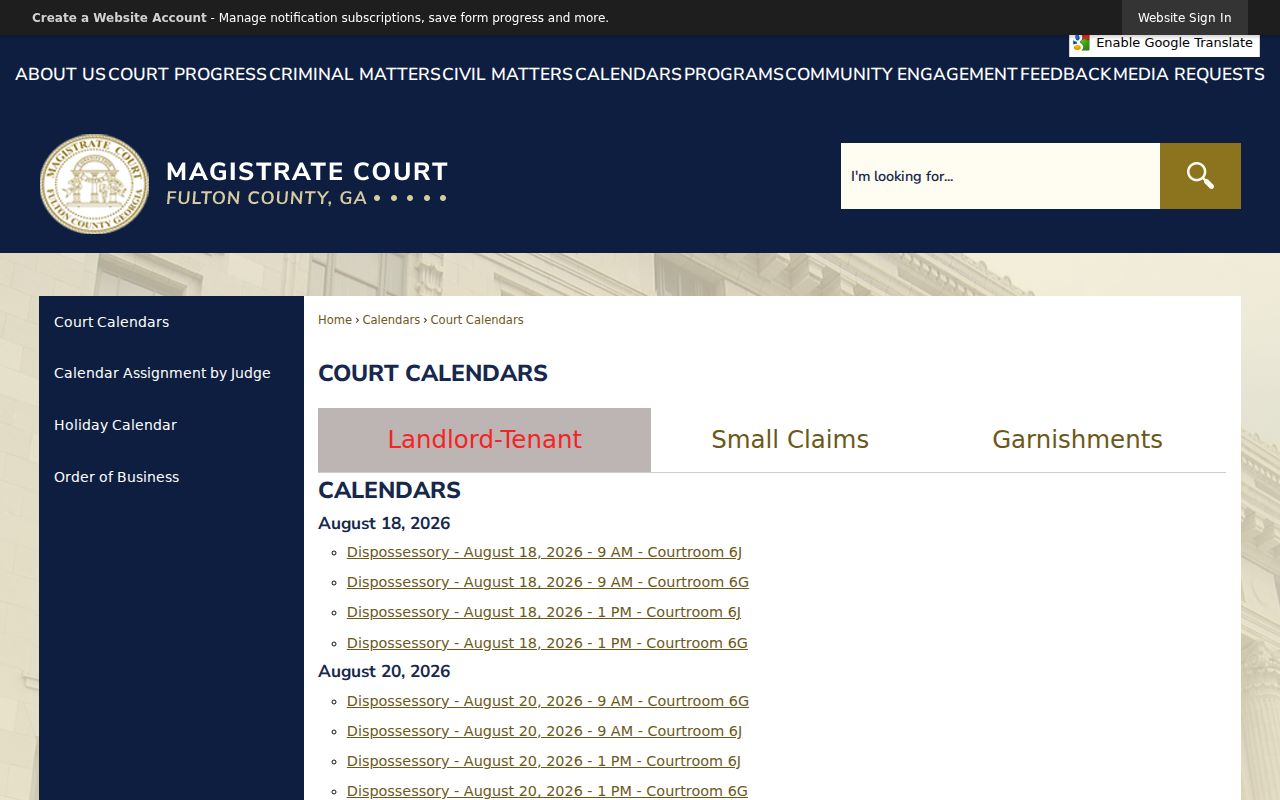
The category and room fields are reminders to pin down the case type before picking a date list. If the board leaves gaps, the case record or the clerk fills them in.
Find Your Fulton County Court Date
One clue is never enough. Bring the court name and the case number if you have it. Names alone can match several cases. The official Find a Case page is wrong. Correct: The official Find a Case page routes Superior, State, and Magistrate searches to the current record system.
- Read the summons, citation, notice, or prior order and identify the issuing court.
- Search Fulton Odyssey by case number or name and choose the matching court and case type.
- Review the newest hearings and events, including any later reset or order.
- Check a court-specific calendar, including a Magistrate board or city calendar, when available.
- Confirm the time and room with counsel or the responsible clerk if sources conflict.
For Superior and Magistrate records help, call 404-613-5313 or visit the Clerk's counter. State Court uses 404-613-5040. Courtroom postings and the day's docket call give an on-site check, but they do not replace confirming ahead of time.
Fulton State Court Calendar Routes
Fulton County State Court is its own limited-jurisdiction court. Misdemeanors, traffic matters, and civil claims fill its docket. Its records operation is separate from the Superior and Magistrate Clerk office run by Ché Alexander. Check the county's State Court overview to confirm jurisdiction and location before trusting a hearing entry.
The official State Court page shows this split.
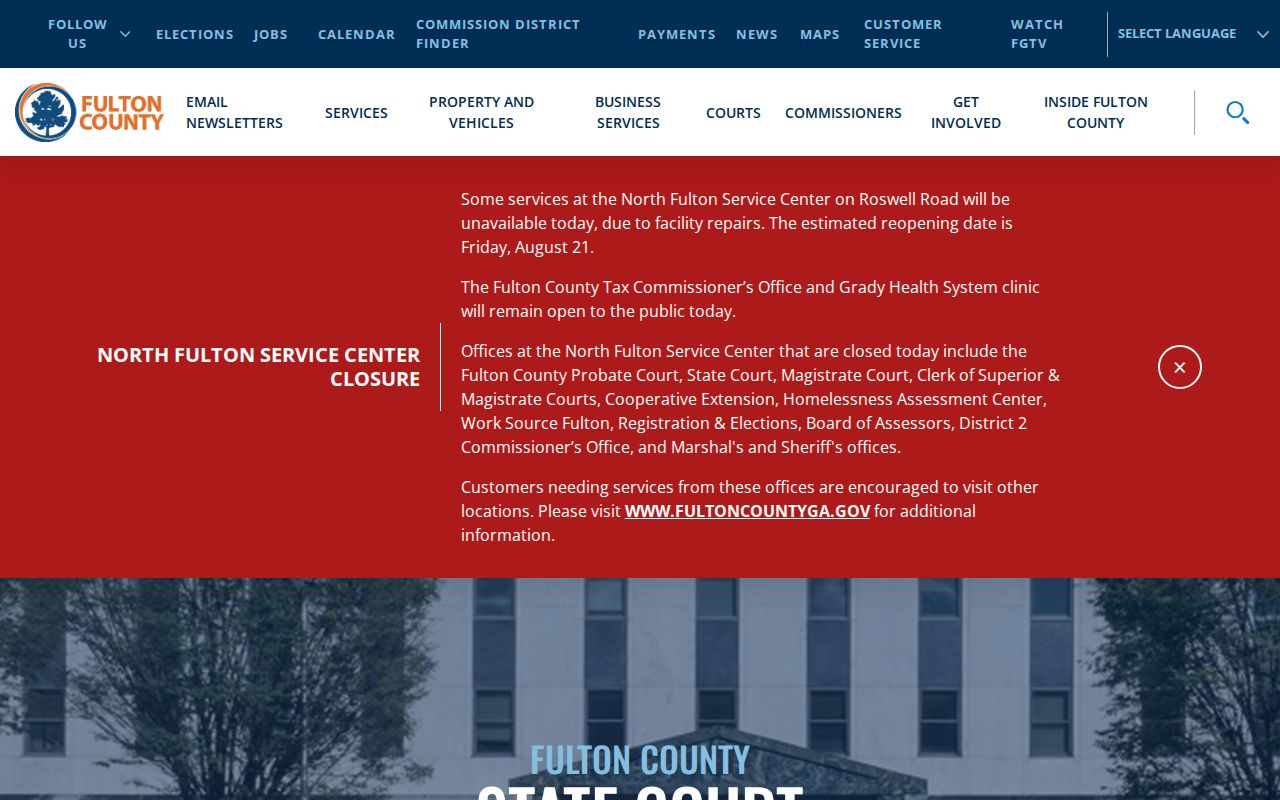
Check a State Court setting through the State Court record and division. Never assume it shows up on a Superior Court calendar. Traffic dates also run through the citation page and the Traffic Violations Bureau.
Reading a Fulton County Setting
A calendar line in Fulton County tells only part of the story. Match each field against the latest docket event. An arraignment is not a trial. A calendar call may manage a whole group of cases instead of setting one witness hearing, and room numbers can point to different downtown buildings or to a service center.
| Date | The scheduled day; check for a later reset or order. |
|---|---|
| Time | The session or docket-call time, not always the order in which cases are heard. |
| Courtroom | The room and sometimes the courthouse building or service center. |
| Judge | The assigned or presiding judicial officer; verify current assignments. |
| Setting Type | Arraignment, dispossessory hearing, status conference, pretrial, or trial. |
A setting is a plan. A disposition is a result. When a listing omits the room or event type, ask the division or clerk rather than guessing from a prior date.
Fulton County Calendar Terms
Local labels describe the event planned, nothing more. They do not decide the case. Magistrate calendars group by case type, while Superior and State histories can list more kinds of events.
- Calendar call
- A session used to call and manage a group of pending cases.
- Reset
- A new date for a setting that did not proceed as first scheduled.
- Continuance
- A court-approved delay; a request alone does not grant it.
- Status conference
- A check on progress, scheduling, or unresolved issues.
- Disposition
- The recorded outcome, not merely the next hearing date.
Landlord-Tenant, Small Claims, and Garnishments mark distinct Magistrate docket groups. Open the group matching the pleading, then still confirm the individual case.
Fulton County Calendar Resets
Resets, continuances, and cancellations surface in the record. They appear as a new event, an order, a notice, or a changed calendar line. The public view can lag behind what the court has done. A request made aloud is not an approved continuance. Hold onto the prior notice and note who gave you any new information.
When a date vanishes, search the full case history for a later entry. Confirm the case number and court. Similar names lead to the wrong file fast. Reach the assigned division, the attorney, or the right clerk. A city matter may not enter a county record. It stays out until formally transferred and filed.
Note: A pending reset request does not excuse attendance. The court must confirm the date changed.
When Fulton Odyssey Shows No Date
A blank Odyssey result can mean a few different things. Some records sit behind registration. A filing may still be waiting to be indexed. Your search terms may also be too narrow. The case could also live in Probate, Juvenile, or a municipal court instead. Georgia's E-Access directory points you toward each court system. It is not a single statewide docket search.
Search the exact case number first, then try name variants. Look at the date printed on your most recent paper. Public terminals reach both Odyssey and eFileGA. Find them at 136 Pryor Street and the Justice Resource Center. Staff can assist with access, but they cannot offer legal advice. For a fuller walkthrough of number and name searches, see the Fulton County case search.
Confirm the Fulton County Courtroom
Downtown Fulton County court hearings happen across several buildings. The Justice Center Tower sits at 185 Shirley C. Franklin Boulevard SW, the Lewis R. Slaton Courthouse at 136 Pryor Street SW, and the Charles L. Carnes Justice Center at 160 Pryor Street SW. State Court's own page lists 185 Central Avenue SW. Magistrate matters can also land at the North or South Service Center.
A room number alone tells you nothing without the building. Match the room against your notice and the current court source. Temporary operations notices sometimes change entrances or hours. Before you travel, confirm everything on the official court site so you do not stand at the wrong door.
Best check: Match the court, case number, date, time, room, and building. One field alone is not enough.
Missed Fulton County Court Settings
Missed a court setting in Fulton County? Act fast. Call your lawyer first if you have one; otherwise phone the clerk or division handling the docket and ask what it shows and which process now applies. Do not pick a new date or show up in a different courtroom, because the judge, not the portal, controls the next step.
Missed a Setting? A missed appearance may lead to a failure-to-appear entry, warrant, bond action, default, or another case-specific result.
Contact the court or your attorney and confirm any new date in the official record.
Traffic matters have separate court and DDS effects, so follow the issuing court's directions.
Skipping a civil hearing can weaken a claim, a motion, or a defense. Criminal and traffic cases carry more urgent consequences. The calendar only shows when a matter was set; the court and docket tell you its current status.